Flushes (2)
The most important part of flush play is really the technique of calling,
but that belongs in Chapter 5.
This page focuses on the hand techniques specific to Honitsu.
1. Transition Play
Example 1


 Pon
Pon 

Example 1 is a discard choice after calling .
The correct play here is to discard .
By keeping the connected souzu shape,
you preserve the option to transition into a souzu Honitsu later.
Tsumo  Pon
Pon
If it is still early in the hand,
then even if you later pon and and pass on a cheap tenpai,
you can still keep heading for Honitsu.
Example 2


 Tsumo
Tsumo  Pon
Pon 

Example 2 is a choice of final tenpai shape.
Even if it means one fewer tile in the current wait,
the theory says you should take the tanki wait instead.
That is because no matter what pinzu or honor tile you draw next, the hand can still turn into Honitsu.
Tsumo  Pon
Pon
If you draw something like and turn it into a multi-sided wait, that is ideal.
2. Advance Discards
Even if camouflage is an old-fashioned tactic overall,
it can still occasionally be effective in Honitsu.
Example 3
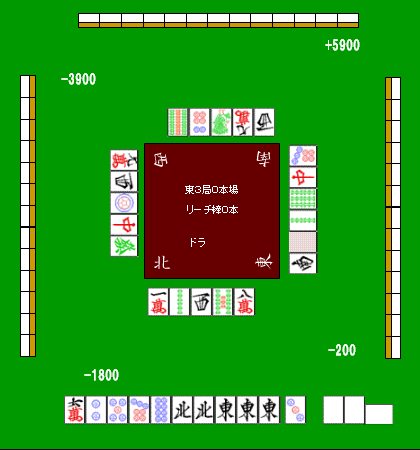
Since the necessary melds are already in place, you should not casually cut .
You should start with  instead.
It is only a small adjustment, but it makes the Honitsu much harder to read.
The example image shows a draw of ;
even if you draw , it is still better to cut .
3. Stronger Shape Recognition
When you concentrate tiles of the same suit, the shapes become more complicated.
Every now and then you even see people get lost on closed Chinitsu waits,
trying to split the hand into groups of three and puzzle it out.
This is ultimately just a matter of familiarity.
Example 4

 Tsumo
Tsumo  Pon
Pon 
This is probably a shape that makes plenty of people hesitate.
The correct answer is to cut
and take the / / wait.
In actual play, it is easy to accidentally forget which tile you already pon'd, so be careful.
If you instead take the / / wait, there are only 5 winning tiles.
Example 5


 Tsumo Pon

It is also worth memorizing some of the representative irregular waits.
The hand is already a three-sided wait as it stands,
but cutting to take the wait is better in terms of point value.
Ittsuu is another yaku that is easy to overlook, so do not forget it.
Original Japanese page: http://beginners.biz/teyaku/teyaku07.html