Folding Procedure (3)
Now let us work through concrete examples.
Example 1
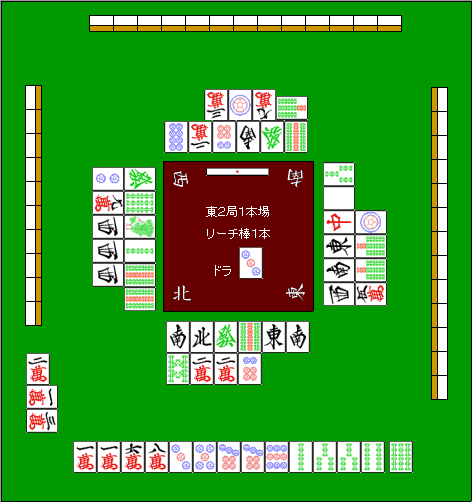
The two players on your left and right also look like they are already folding,
so this is a position where you only need to focus on fully folding against this one riichi.
Here, the discard order from safest to least safe is:
 ->
->  ->
->  ->
-> 
As long as no new genbutsu appear,
that is basically the order you will keep folding in.
is almost completely safe.
It is both no-chance and the third visible copy, so if it hits at all, it is mostly only something like a chiitoitsu tanki wait.
Also, tiles that were called are easy to overlook, so be careful about that.
Next come the suji tiles.
The suji here are and .
But can still hit a kanchan wait, and it can also fit a tanyao hand.
So you should definitely cut first.
Once the suji are gone too,
you have no choice but to break the pair of .
The reason this pair is broken is that  was discarded very early,
so is at least a little safer;
and once one copy passes, the second copy usually becomes easier to pass as well.
Example 2
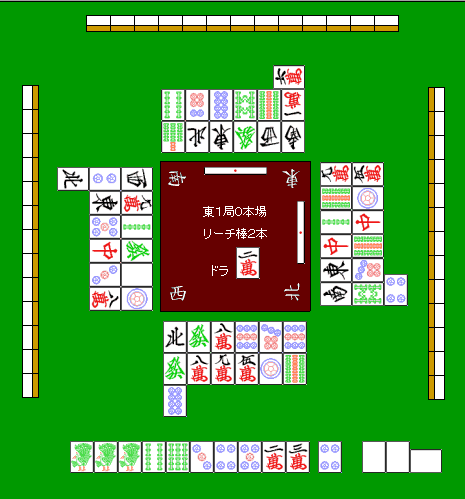
This is a late-hand position where two riichi declarations have come in back-to-back.
In a double-riichi situation like this, with no common safe tile,
sometimes you also consider cutting a genbutsu against only one of them.
But here, the dealer's only genbutsu is  , and that tile is quite dangerous against the player below.
The completely central non-suji  is of course not a tile you can cut into the dealer's ippatsu turn.
At a moment like this, it is dangerous to think,
"It is a genbutsu against the earlier riichi, so the later riichi probably will not be waiting on it."
 is technically suji,
but since it is right next to the dora, it is still hard to cut against the dealer.
And once the discard rows have reached the third row,
one-chance information such as  is no longer trustworthy at all.
So here, the better recommendation is simply to cut three copies of  in a row.
The reasons are:
- it is fairly safe against the dealer
- judging from the early discard of
 by the player below, also looks relatively likely to pass there
Theory
The farther a number tile is from the riichi declaration tile, the safer its outer suji usually is.
Once you start folding a lot, you will find this is a surprisingly useful rule, so it is worth remembering.
For example, the farther  is from the riichi declaration tile,
the safer usually becomes.
Even if the opponent had a shape like ,
they normally would not cut that early if their hand was still unformed in the opening.
And even if they really did cut it early,
by the time they reach riichi, that ryanmen often gets filled in and changes into a different wait anyway.
Original Japanese page: http://beginners.biz/mamori/mamori08.html