Thinking About Yaku (2)
1. Yaku Are Something That Forms Naturally
Basically, yaku are not something you force.
They are something that forms as the hand develops.
Some players decide on a final shape in advance and then cut every tile that does not fit that target.
This kind of play is called commitment-based hand-building, and it is something you should avoid completely.
In mahjong, you cannot choose what tile you draw.
The tile you tsumo exists independently of your intentions.
So the iron rule is to shape your hand around the draws you actually receive.
Rigid commitment is taboo.
Example 1


 Tsumo Dora
Suppose you are in last place and receive this garbage starting hand with 8 kinds, 9 terminals and honors.
If someone starts by cutting the dora and hard-commits to Kokushi, that is losing play.
Why throw away, from turn one, the possibility of stacking the dora into Chiitoitsu?
Even if you want to leave Kokushi in the picture, then in non-red rules you should cut or ,
keeping possibilities like Chanta or Chiitoitsu alive.
In red-five mahjong, cutting is fine.
If you are dealer, then cutting is unquestionably correct.
Even a starting hand like this can still win by stacking value honors.
Everything depends on the future draws.
There is almost nothing to gain from rigid commitment.
It mostly means throwing away possibilities with your own hands.
Natural hand development is the best way to play.
2. What Is the Advantage of Yaku?
People tend to think the value of yaku is higher score,
but in modern mahjong, dora, red fives, and chips are often stronger sources of profit.
It is better to think of yaku like this:
yaku exist so that you can call.
Example 2
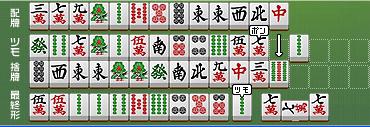
At first glance, this looks like a lucky game log where someone just happened to win with three red fives.
But the player is actually making a very deliberate yaku-oriented choice.
You can see that they even gave up the pairs of and 
just to keep the value-honor possibility.
They are North seat, so North is yakuhai, while East is only a guest wind in South round.
In chip-based red-five rules, a hand with two red fives is a hand you absolutely want to win.
But if you insist on keeping it closed, the hand is still far from riichi.
So the player adds Tanyao or Yakuhai as a yaku,
and converts the hand into a shape that can win by calling.
Being able to call is extremely important in red-five mahjong.
Having a yaku = being able to call = being faster
The modern way to think about it is that yaku can also be a speed-up tool.
That is exactly why Tanyao is so highly valued in red-five mahjong: it lets you call freely.
3. The Drawbacks of Yaku
Different yaku have different drawbacks,
but the biggest one is that they reduce your acceptance count.
Example 3


 Tsumo
Tsumo 
In a shape like Example 3, discarding naturally leaves the possibility of 234 Sanshoku.
Example 4
 Tsumo
Tsumo
But in Example 4, aiming at Sanshoku actually reduces the acceptance count.
| Discard | Tenpai chances | Count | Comment |
|---|---|---|---|
|
  |
16 |
Includes Sanshoku possibilities |
|
|
12 |
Sanshoku guaranteed |
|
 |
19 |
|
|
|
23 |
Maximum tenpai chances |
Even though chasing Sanshoku would raise the value of the hand,
in this shape, the best choice is clearly discarding , which gives the widest path to tenpai.
When you must sacrifice either yaku value or speed,
in most cases, prioritizing speed gives the better result.
Another drawback of yaku is that they restrict which kinds of tiles you can use.
If dora is in pinzu and you go for a souzu Honitsu, then the dora becomes unusable.
If you aim at Chanta, drawing a red five becomes awkward.
And many players have experienced this too: you reach Chiitoitsu tenpai under riichi pressure, then draw the fourth copy of one of your pair tiles and get stuck.
Remember this well:
yaku can sometimes drag down both speed and defense.
Original Japanese page: http://beginners.biz/teyaku/teyaku02.html