Tile Theory at One-Shanten (1)
Tile theory at one-shanten is the most important skill in hand-building.
The reason is simple: it has a huge impact on your winning rate.
If a hand is so poor that it is unlikely to win no matter what you do, a slightly inefficient choice may not matter much. But once you are this close to completion, a mistake can be fatal.
1. Basic Approach
You can choose your discard by following the flow below.
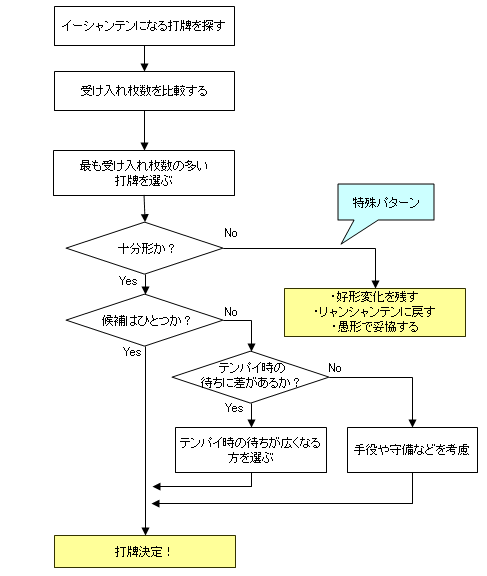
Read the chart from top to bottom. The diamond shapes are branch points.
The hardest part is the special cases: hands where even the discard with the maximum acceptance is still not good enough to count as a truly sufficient one-shanten.
2. Basic Patterns
The line for a "sufficient shape" is not absolute, but as a practical benchmark, I consider 16 or more accepting tiles enough.
Some people may think that standard sounds too demanding. But even with 16 accepting tiles, it still takes an average of 7 to 8 turns to move from one-shanten to tenpai. Since a hand only lasts about 18 turns, that is barely enough.
Example 1


Discard . The one-shanten shape then has 16 accepting tiles, which is good enough.
Of course, if the souzu side fills first, the hand may end up in a bad wait. Even so, that does not justify cutting the manzu side and sacrificing four tiles of acceptance.
When there are two or more discards tied for the highest acceptance, or when the difference is only one or two tiles, the next thing to compare is the quality of the wait after tenpai.
Example 2
Discarding and discarding both leave 16 accepting tiles, so here you should compare the resulting waits.
Discarding is more likely to produce a ryanmen wait.
Example 3


This is already a sufficient shape, and there is no meaningful difference in either the number of one-shanten entries or the quality of the eventual waits.
That means scoring potential should decide the choice. Keep and continue aiming for 678 Sanshoku.
Up to this point, the decisions are still not too difficult.
3. Insufficient Shapes
Example 4


With only 12 accepting tiles, this should be treated as an insufficient shape.
The first thing to consider is improvement into a better shape.
The floating and the connected pinzu shape have completely different power when it comes to forming ryanmen waits. In Example 4, cutting is the correct first move.
Example 5


Besides taking the obvious one-shanten line, Example 5 also has another option:
drop back to two-shanten.
The reason is that you want to avoid a wait on , where you already use one copy yourself.
Scoring value from yaku such as Tanyao and Pinfu, and the winning rate after Riichi, which also reduces the chance of taking damage, mean that simply taking one-shanten is not always the best choice.
That is part of what makes mahjong difficult.
I think discarding is best here.
On the following pages, this same line of thinking will be used to examine one-shanten tile theory much more thoroughly.
Original Japanese page: http://beginners.biz/pairi/pairi13.html