Playing by Tile Theory
Tile theory is the theory of completing four sets and one pair as efficiently as possible. It is one of the central foundations of hand-building in mahjong. A closely related term is tile efficiency.
If you think about mahjong one hand at a time, it is essentially a game of:
"which of the four players can complete four sets and one pair the fastest?"
That is why the basic rule is to choose your discard according to tile theory.
A mahjong hand has three elements: speed, value, and defensive strength.
Of those three, speed is the most important.
That is because speed can cover for both value and defense.
No matter how valuable a hand is, if it never wins, it cannot add points. And winning quickly also stops an opponent from winning with a hand that might otherwise have come in later, so it is fair to think of a fast win as being worth your actual points plus extra hidden value.
Also, if you win before the opponents even reach tenpai, you cannot possibly deal in. Speed is the life of the hand. Keep in mind that getting distracted by yaku and missing a win is one of the worst mistakes you can make.
"Showy elegance only delays the turn on which you could actually win."
That line comes from the manga Aburemon. It really is a fine quote.
That is enough introduction. Now let us talk about what it actually means to play by tile theory.
Example


For example, how should you think about this hand?
You can see the outline of Chanta, and if the souzu block becomes an upper sequence, Sanshoku is also possible. Beginners often get trapped into thinking only about which yaku they remember and which of them might be possible.
As a result, they often make a mistake like this:
Tsumo Dora
Dora
At this point, they cut .
What matters is to start thinking in terms of how the 13 tiles, plus the drawn tile, are structured.
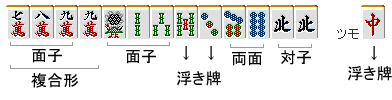
This hand can be broken down like that.
Among the target structure of four sets and one pair, what is still missing? Two sets and one pair are already complete.
Since can be counted as one future set,
all that remains is to build one more set.
There are no other taatsu in the hand,
so that last set has to come from .
If that is the case, then which of those tiles is the hardest to turn into a taatsu...?
Once you think this way, the question of what to discard in mahjong often stops being so difficult. Analyze the hand, use elimination to list the discard candidates, and then compare those candidates against one another.
The important thing is comparison. Once you start comparing, the number of wrong discards drops dramatically.
In this hand, the tiles not currently being used in sets or taatsu are
.
Those are your discard candidates.
Understand what function each of them has, and then think about which one is the least necessary.
List the discard candidates, then compare them, again and again.
That is what it means to play by tile theory, and it is one of the true basics of mahjong.
Original Japanese page: http://beginners.biz/pairi/pairi01.html