Number Tiles and Honor Tiles
There are 34 kinds of tiles in mahjong.
Let us think about what functions those tiles have.
How Mahjong Tiles Are Classified
Mahjong tiles can be classified as follows.
• Number tiles
[Manzu] 


[Pinzu] 


[Souzu] 


• Honor tiles
[Wind tiles] 


 [Dragon tiles]


The numbered tiles from 1 to 9 exist in three suits: manzu, pinzu, and souzu.
Souzu technically has a yaku called Ryuuiisou, but for practical purposes these three suits can be treated as having the same value.
However, if a suit contains the dora tile, the overall value of that suit rises slightly.
Some parlors use red fives only in pinzu,
and in that case pinzu becomes the strongest suit.
Still, this is not something you usually need to think about very much.
Honor tiles consist of wind tiles and dragon tiles, seven kinds in total. Dragon tiles can basically be treated as equal in value (because the chance of Ryuuiisou matters so little), but wind tiles may or may not be value tiles depending on your seat, so you need to pay attention.
Honor Tiles
Dragon tiles are convenient because simply making a triplet gives you a yaku.
If dragon tiles are the dora, be careful not to confuse the order.
The indicator and dora cycle as White -> Green -> Red.
Wind tiles become value tiles in some cases and not in others.
(1) The round wind is a value tile.
East in East round, South in South round, West in West round, and North in North round.
Since most games are played as East-South or East-only, West and North are not often the round wind.
(2) Your seat wind is a value tile.
East for the East seat, South for the South seat, West for the West seat, and North for the North seat.
This is commonly called your jikaze, or seat wind.
The dealer's wind is East, so you should be able to work out the other players' winds from there.
(3) Any other wind tile, called an otakaze or guest wind, is not a value tile.
East for the dealer in East round, and South for the South seat in South round, each satisfy both (1) and (2),
so they are double winds and count as a 2-han yaku.
These are the familiar double-East and double-South situations.
Naturally, that makes them the most valuable kind of value tile.
A guest wind with no yaku is the least valuable honor tile. If you start with only one copy in your opening hand, it is often a strong candidate to discard first.
Number Tiles
Number tiles run from 1 to 9,
but there is a huge difference in how well each tile works for making sets.
The following diagram makes that very clear.
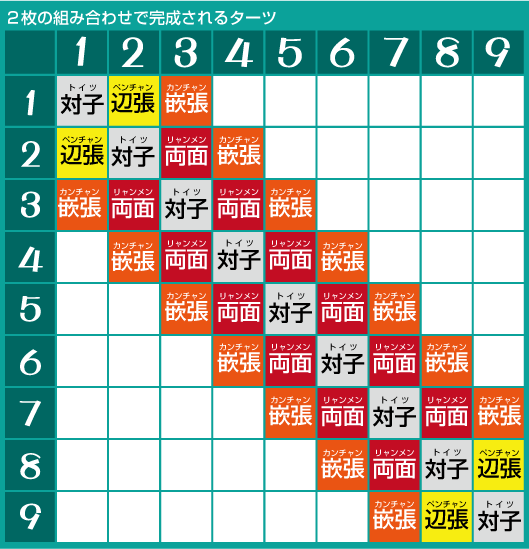
Tiles from 3 to 7 can form taatsu with four different tile types,
consisting of two ryanmen possibilities and two kanchan possibilities.
For 2 and 8, the effective tiles drop to three kinds,
and only one of those possibilities, 3 or 7, makes ryanmen.
For 1 and 9, the number of effective tiles drops to just two,
and they can only become poor shapes such as penchan or kanchan.
So number tiles in mahjong can be ranked roughly like this.
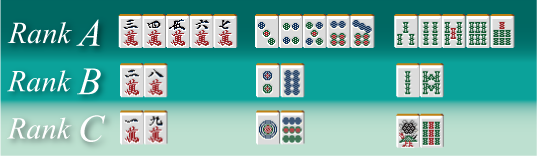
There are slight differences even among the rank-A tiles from 3 to 7,
but worrying about those tiny differences is mostly just self-satisfaction.
You do not need to pay special attention to them.
It is enough to remember that tiles near the middle are stronger than tiles near the edge.
Why are edge tiles weak?
The fundamental reason is simple:
mahjong tiles can form sets like 1-2-3 and 3-4-5,
but they can never form a set like 8-9-1.
Sets are built around the middle tiles from 3 to 7.
The key to hand-building is to use those inner tiles well to make taatsu and complete sets.
Theory and Summary
Original Japanese page: http://beginners.biz/kihon/kihon05.html