Basic Shapes and Composite Shapes
At this point, all of the basic mahjong shapes have appeared.
- Sets (triplets, sequences, quads)
- Taatsu (ryanmen, kanchan, penchan)
- Pairs
- Isolated tiles
Every mahjong hand can be broken down into these four categories.
Let us look at an example.
Example 1 


Suppose you are dealt a starting hand like this.
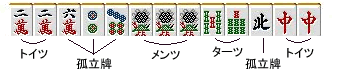
As shown above, you can divide it into basic shape components.
Thinking about your hand in terms of these parts is extremely important. To avoid simple mistakes, beginners should play with their tiles carefully arranged.
Example 2 


Now what about Example 2?
The manzu, pinzu, and souzu parts are all composite shapes.
If you try to force them back into basic shapes, problems appear. For the manzu part, for example, you could read it as:
(taatsu) + (pair) +
Or you could read it as:
(set) + +
Neither interpretation is the one correct answer.
I strongly recommend this way of thinking instead:
treat a composite shape as a composite shape.
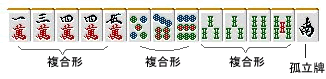
Mahjong tiles create complicated functions when they combine with one another. The best way not to overlook those functions is to learn the properties of each composite shape as knowledge in its own right.
The number of composite patterns is endless, so you will never cover every one of them. But as you keep playing, your eye for shape becomes stronger, and even when you meet a rare shape, you will be able to respond to it more naturally.
From here on, we begin introducing the most basic composite shapes.
Theory and Summary
Original Japanese page: http://beginners.biz/kihon/kihon08.html