Calling Techniques (3)
The last page in this set of calling techniques is not about winning with your own hand.
It is about using calls to interfere with an opponent's win.
Some players show obvious irritation when these tactics are used against them.
So if you use them in real play, do it with some care.
Cancelling Ippatsu
Once any call is made after a riichi, the right to ippatsu disappears.
The actual chance of ippatsu is not high enough that you should take a real risk just to erase it.
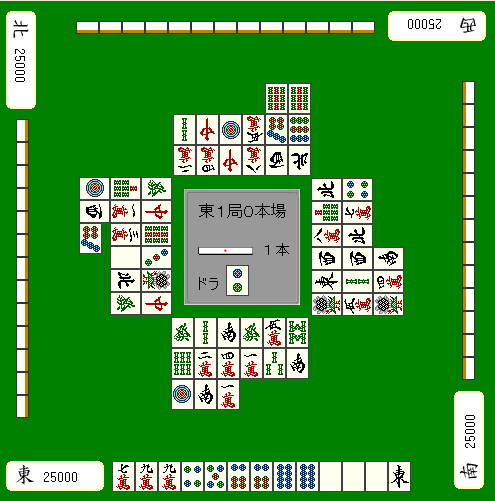
But if it is completely risk-free, cancelling ippatsu is simply profitable.
In the situation above, trying to push for tenpai is already unrealistic.
So the best move is to call  only to erase ippatsu, then begin folding by breaking the concealed triplet of
  .
.
Blocking Pon
When the same discard could be used for both chi and pon, pon normally has priority.
Some local rules say that if the chi call was clearly voiced first, chi takes priority instead.
But under the usual rule set, you can sometimes use pon to block a tile that an opponent wanted to chi.
Shifting or Removing Haitei
If someone tsumos the very last tile of the hand, they gain one extra han for haitei.
So in the late game, if someone has riichi and you have a way to remove or shift the last draw, it is generally safer to do so.
This matters even more in rules with renchan on win.
Simply removing one last draw from the dealer can already have real value.
Conversely, even if you are only trying to take a formal tenpai, it is still questionable to chi carelessly and give the riichi player more draws.
Kan That Does Not Aim at Winning
People who kan carelessly are often treated as beginners.
But if you understand the hidden uses of kan, there are situations where it can clearly pay off.
For example, suppose the player below you has declared riichi, and their final draw would otherwise be the haitei tile.
If you have a tile set that can be used for kan, you can save it until your own final draw.
By declaring kan at that moment, the haitei tile shifts by one position.
That removes both the riichi player's last draw and the haitei bonus at the same time.
It is often said that once your hand is already open, you should avoid kan as much as possible, because it gives extra dora to the table.
But if you are currently in last place, there are situations where even a daiminkan can be worth considering.
The point is not only to hope for kan dora.
If the round inflates, another player may make a huge hand, and someone else may deal into it, changing the standings in your favor.
Even if you are in second place, if the player barely ahead of you is the dealer, and the player in last has riichi, this kind of kan can still make strategic sense.
The aim is to create a chance for the dealer to take the hit and for you to move up in rank.
But this only works when both conditions are met:
- You must have enough safe tiles to fold out completely.
- You must not be in danger of being overtaken by the player in last.
When the conditions line up, this kind of kan is worth considering.
Original Japanese page: http://beginners.biz/naki/naki15.html