Kabe
Another important way to look for safer tiles is kabe.
No-Chance
For example, if the opponent is waiting on  -
-  ,
,
then they must be holding at least one  and one
  .
.
That means if all four copies of or all four copies of are visible on the table,
then the opponent cannot possibly have a - wait.
There are only four copies of each tile in mahjong, so this is obvious.
Therefore, becomes fairly safe.
One point to watch carefully is that is not safe just because of this.
That is because a -  wait is still entirely possible.
Here is a chart you can memorize directly:
| Tile Seen in All Four Copies | Tiles Made Relatively Safe by Kabe |
|---|---|
1 |
none |
2 |
1 |
3 |
1 and 2 |
4 |
2 and 3 |
5 |
3 and 7 |
6 |
7 and 8 |
7 |
8 and 9 |
8 |
9 |
9 |
none |
One-Chance
If three copies of a particular tile are visible, that is called one-chance.
Since the last copy is still unaccounted for, the riichi player may still be holding it.
Unlike no-chance, this still leaves plenty of room to deal into a ryanmen wait.
So one-chance should only be understood as follows:
- it still has some value early in the hand
- it is almost unreliable in the late game
If three copies of a tile are already visible early on, there is still a good chance the last one is buried in the wall,
so one-chance can still be fairly trustworthy.
But the later the hand goes, the less trustworthy it becomes.
Also, suppose the riichi player has already discarded  .
.
Because genbutsu against the riichi player tend to get discarded more often, one-chance can easily be created artificially.
Especially if the other three players are all folding and the last still never appears,
then the final copy is actually quite likely to be in the riichi player's hand.
Likewise, if a kabe exists but the outside tile still never shows up for a long time,
you also need to suspect a shanpon wait.
That applies to no-chance as well, not just one-chance.
In any case, one-chance is not something you should rely on too heavily.
Theory
One-chance can still be used as a guide early in the hand, but you should not trust it late in the hand.
Double One-Chance
There is also a stronger version of one-chance.
For example, if both and  are visible in three copies,
then the chance that the opponent is holding both tiles at once becomes much lower.
This is called double one-chance, and in that situation  becomes fairly safe.
In terms of safety, you can roughly think of it as:
No-Chance > Double One-Chance >> One-Chance
Using Kabe
Now let us actually try using kabe to find a safe tile.
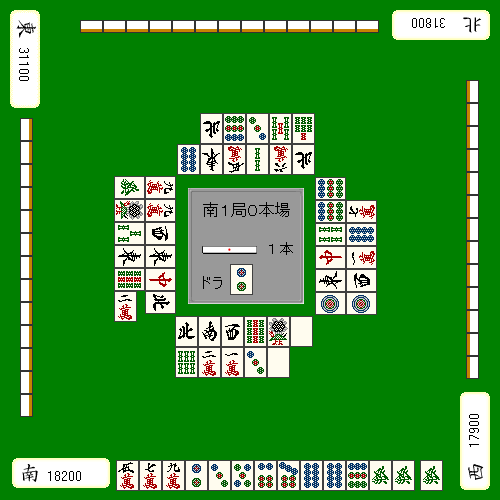
Cutting the riichi player's genbutsu  would not be bad,
but in this case the better answer is to cut  .
.
Because all four copies of  are visible, a ryanmen wait is impossible.
And in this position, itself is also the fourth visible copy.
That means shanpon waits and tanki waits are both ruled out as well.
Of course kokushi musou is also impossible here,
so is a tile that will pass 100%.
Original Japanese page: http://beginners.biz/mamori/mamori05.html