Hand-Building and Situation (2)
Next, let us think about hand-building that responds to the table situation. There are times when you should look at the tiles already discarded on the table and the tiles other players have called, and adjust your hand-building according to that situation.
React to Thin Tiles
When you look at the discard rows, first check how many of the tiles you need have already been discarded.
This is the most basic part of situational judgment.
Example 1
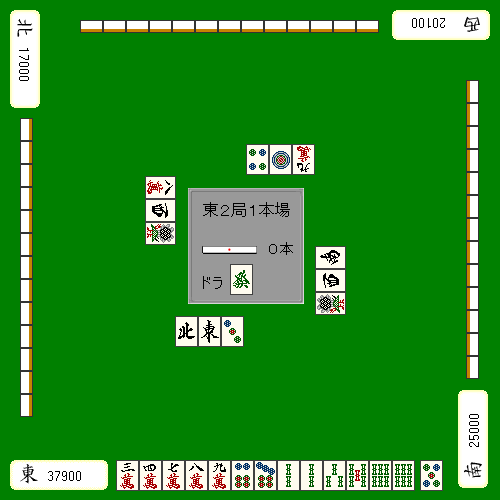
The question here is which souzu ryanmen acceptance you should dislike more.
The answer is on the table.
If  is already out in two copies, then naturally you should cut
  .
.
Pay Attention to Which Suit Is Strong
Example 2
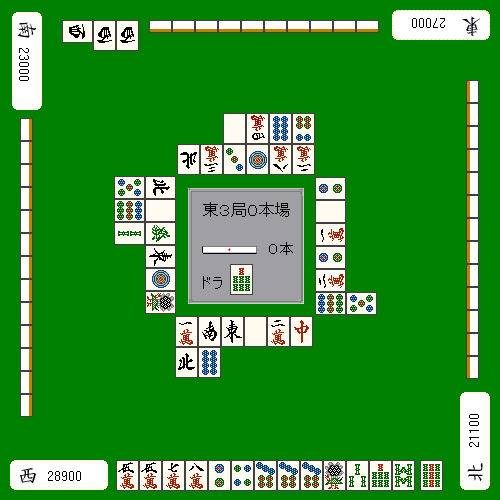
The dealer has called the guest wind  .
.
That means they are going for a souzu Honitsu.
Your own hand is one-shanten with the dora meld already complete.
Since you are over-complete in melds, the choice is which kanchan to remove: the souzu one or the pinzu one.
Both suits have one visible tile already,
but what really matters is how many pinzu and souzu have been discarded on the table as a whole.
So many pinzu have been cut that it tells you the other players do not need pinzu.
By contrast, because so few souzu are visible, it is easy to infer that souzu are still being used in their hands.
When many tiles of a suit have been discarded like this, we say that suit is cheap in the field.
When almost none of that suit have been discarded, we say that suit is expensive in the field.
In general, waiting on a suit that is cheap in the field makes it easier to win.
Even if a kan  can have at most three tiles left, it can still be called a good wait.
That is because a suit that is cheap in the field is not only awkward for other players to keep,
but also more likely to become one-chance or no-chance,
so the actual winning rate can be higher than the raw tile count suggests.
So the strong play here is to discard:
If you become overly scared of the dealer's flush and start touching the pinzu side instead,
that is too timid.
If you riichi on a kan  wait, it overlaps in suit with the dealer's Honitsu,
so you can expect almost no ron from either side.
That actually makes it more dangerous and more likely to run into the dealer's counterattack.
React to Open Hands
Example 3
Shimocha
 Chi
Chi 

 Pon
Pon 

You


 Chi
Chi  Tsumo
Tsumo 
Against an obviously Chanta-type open hand like this,
if neither tile has passed, then of course you must cut  .
.
Example 4
Kamicha
Pon 
 Pon
Pon 
You

 Pon
Pon 
 Tsumo
Tsumo
When there is an obvious Toitoi-style open hand on the table,
then naturally the unseen tile is much more dangerous as a shanpon wait.
So in Example 4, if you have to discard one of them, you should cut  .
.
If three copies of  are already visible while
  has not appeared even once on the table,
then it is natural to think that someone is holding as a pair.
Original Japanese page: http://beginners.biz/joukyou/joukyou04.html