Tenpai and Shanten
Here we begin learning some of the most important concepts in hand-building. Before thinking about yaku, it is crucial to learn to see a hand in terms of shape.
Winning Hand Shapes in Mahjong
Mahjong, needless to say, is a game in which you aim to complete a winning hand.
Broadly speaking, there are three kinds of winning shape.
(1) Complete four sets and one pair
(2) Complete seven pairs
(3) Complete Kokushi Musou
(2) and (3) are special winning forms.
The standard form is (1), the four-set hand.
And those sets come in two types: sequences and triplets.
[Sequence] 


 ... three consecutive tiles
[Triplet]  ... three identical tiles
So if you look purely at tile composition, the winning forms in mahjong are as follows.
1. Four Sets and One Pair
1-a Four sequences


1-b Three sequences and one triplet
1-c Two sequences and two triplets
1-d One sequence and three triplets
1-e Four triplets
2. Seven Pairs (Chiitoitsu)


3. Kokushi Musou


These winning forms differ greatly in how easy they are to make. Naturally, Kokushi Musou is the hardest, and in return it is rewarded with yakuman, the maximum score.
Strictly speaking, sets also include quads, groups of four identical tiles, but here we will not distinguish them from triplets.
What Is Tenpai?
A shape that is one tile away from a complete winning hand is called tenpai.
If the hand has a yaku, you can win from there.
Example 1 


This hand wins on or .
In mahjong, if you are not in tenpai, you do not get points.
(The only exception is another player's chombo.)
And if you are menzen, meaning you have not called at all, you may declare riichi.
That is why it is so important to reach tenpai as quickly as possible.
Shanten Number
Example 2
This hand is one step away from tenpai.
If you draw , you reach tenpai.
A state in which drawing one more effective tile will make you tenpai is called iishanten.
The tiles that move the hand into tenpai here, ,
are what the original page calls tenpai chances.
The more tenpai chances you have, the easier it is to reach tenpai, so you can regard it as a stronger iishanten.
Example 3 
Example 3 has a very large number of effective tiles:
it is an iishanten with 13 kinds and 42 tiles.
Example 2 had only 3 kinds and 12 tiles, so the difference is close to fourfold.
This shows that even among hands that are both iishanten, the ease of reaching tenpai can differ enormously depending on the tile combination.
The smallest number of steps still required to reach tenpai is called the shanten number.
A hand with shanten number 1 is called iishanten.
A hand with shanten number 2 is called ryan-shanten.
Then come san-shanten, suu-shanten, and so on.
As a small piece of trivia, the farthest a normal mahjong hand can be from tenpai is six shanten.
Example 4
Example 4 is a six-shanten hand. Even the fastest route, a seven-pairs tenpai, still takes six steps.
The shanten number is an extremely important guide to how far you are from tenpai. You should become able to sense how many shanten your current hand is. At the very least, you should clearly distinguish iishanten from ryan-shanten when deciding how to play.
Lowering the Shanten Number
If your hand is ryan-shanten, aim for iishanten.
If it is iishanten, aim for tenpai.
If it is already tenpai, aim to win.
It is important to play with that mindset.

 Tsumo
Tsumo
For example, if you cut here just because it is an edge tile or because it is floating, the hand remains ryan-shanten.
To move into iishanten, you should cut or .
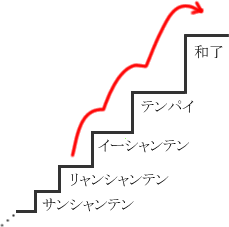
Mahjong is a game in which you reach a win by climbing the steps shown in the diagram. You can never skip one of those steps midway. There are hands where it is better not to lower shanten immediately, but as a basic rule, your discard decisions should be made with lowering shanten in mind.
Original Japanese page: http://beginners.biz/kihon/kihon03.html