Atozuke (2)
On the previous page, I wrote that when you have two or three dora, there are many cases where you should still open even if the hand becomes atozuke.
There are other hands and situations where atozuke is effective as well.
A Key Tile Has Appeared
Example 1


 Dora
Dora
Suppose the player on your left discards  from this hand.
That is obviously a key tile for the hand.
If you let it go, only two copies remain, and one of those is the dora indicator.
In other words, drawing both  and by yourself to complete that block is already very unrealistic.
So here you should chi it as a penchan and turn the hand into atozuke.


After that, what you should do is quickly process and keep one relatively safe tile in reserve.
Or, if you draw another yakuhai, keeping it is also good because it makes the yaku more stable.
This looks like a very typical atozuke opening.
But in real games, opponents usually cannot lock up the yakuhai completely.
And if someone insists on holding it forever, their own attack slows down sharply.
Also, here you have already shown the dora sequence block, so your defense does not get any weaker because of that.
This kind of atozuke is perfectly reasonable.
Two-Track Atozuke
If the entire hand depends only on a single yakuhai, it is naturally harder to feel comfortable opening it.
But if the hand also keeps a second route such as Sanshoku or Ittsuu, atozuke becomes much more effective.
Example 2


 Dora
Dora
With this hand, , , and  are all tiles you should naturally chi without hesitation.
This is not a hand that lives or dies purely on .
Here you are balancing Sanshoku and White yakuhai-back on the same scale.
Example 3


In Example 3, if comes out, pon is automatic.
Many people worry, "what if the never comes?"
But that worry is usually exaggerated.
This hand is not just waiting helplessly on .
If you draw or , it can also develop toward Sanankou or Toitoi.
So the real question is whether the overall win rate stays high after the call.
Here it does, so you should pon boldly.
A Decisive Spot Where You Simply Have to Win
Once you get into South round, you often run into situations where the exact point value no longer matters, and all that matters is winning no matter what.
The typical example is South 4 in a close game where any win means a comeback.
Example 4
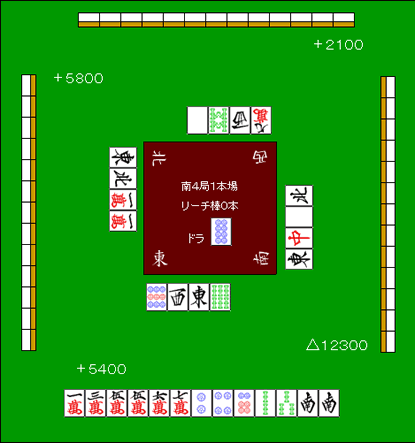
In a score situation like Example 4, it is too soft to keep waiting for  before you decide to open.
This is the kind of spot where you should win even a messy 1500-point hand if that is what it takes.
Call on everything you can. Of course, a pon on 5m that clearly wrecks the structure is still bad.
And in this kind of South 4 close game, the opponents are also desperately trying to win themselves, so they usually do not have the spare room to clamp your yakuhai forever.
That is exactly why atozuke becomes an effective weapon in this kind of endgame fight.
Original Japanese page: http://beginners.biz/naki/naki12.html