Push/Fold in Real Hands
From this page onward, we move into more realistic push/fold examples.
The assumed rules are the common red-five format with:
- ippatsu
- ura-dora
- three red fives
The images were made under those rules, with no betting-chip bonus.
I will also try to introduce some smaller reading techniques here and there, including things that did not fit naturally into the earlier lessons.
Example 1
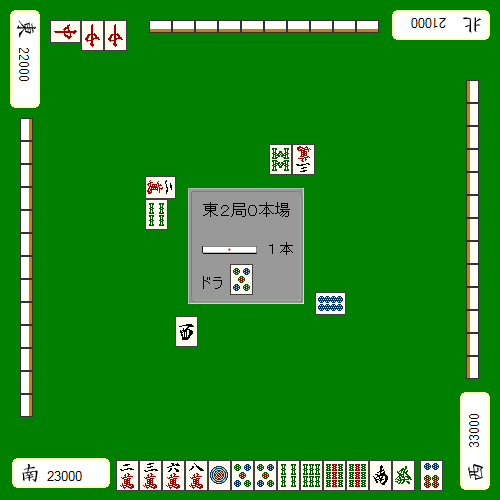
In actual play, you will often be hit by a very fast riichi like this.
Many players instinctively throw an honor tile first, but there is really no practical way to catch up to a fast dealer riichi here.
You should quietly pull out the genbutsu  first.
After that, you also shed  , and only once the genbutsu run out do you move on to honor tiles.
Answer: cut
Example 2
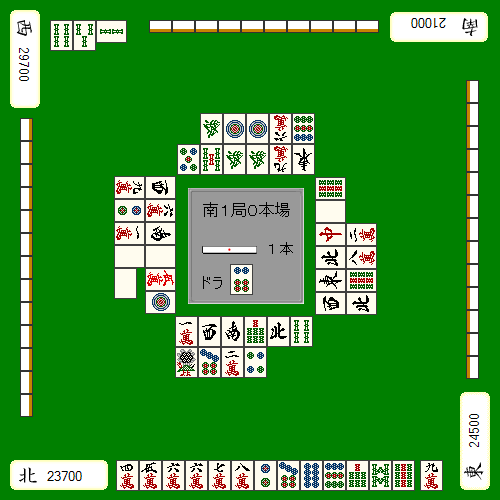
The wait is thin, only four  and one
  ,
,
but this is still a real fighting hand, so you go riichi.
If all you wanted was a cheap win, you could cut  and damaten,
or even cut  and damaten,
but the point situation says you want mangan here.
And since the player in first place has already riichi'd, this should be treated as a direct-hit opportunity.
Answer: cut and declare riichi
Example 3 (the player across from you discards  )
)
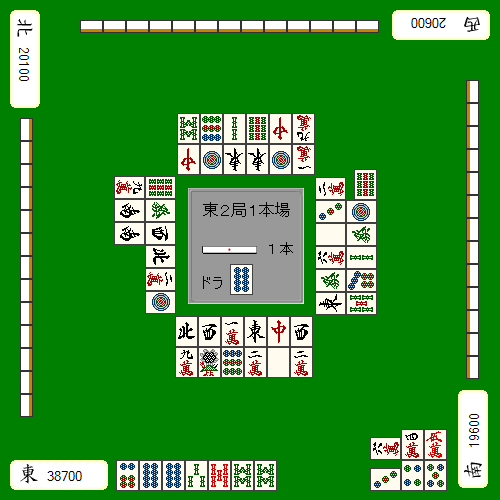
Even though you are currently in first place, this hand has more than enough value to fight with.
In East round, if you can take a dealer mangan tenpai, you should keep pushing for more points.
At the very least, you want to continue until you start drawing truly dangerous live tiles in the late hand.
Answer: pon and take tenpai
Example 4
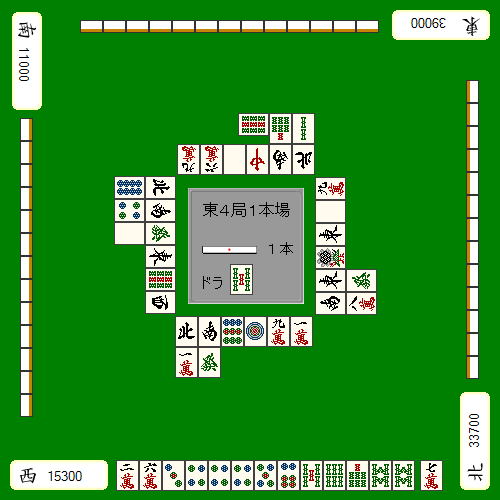
The best plan here is to cut the no-chance  first.
Then continue with the following policy:
- if you reach tenpai, chase riichi
- if you draw two live dangerous tiles in a row, stop
- if you draw a suji tile or an honor tile, keep pushing a little longer
Even with a good hand like this, if you are still not in tenpai, you cannot just shove live tiles into a dealer riichi.
Also, because this riichi came from dropping a kanchan, the even worse penchan is not an especially natural wait.
On top of that, all four  are visible, so there is no pinzu ittsuu possibility.
If it hits anything, it is more likely to be a shanpon, or some unusual shape such as 123 sanshoku or a souzu shape like 6779.
Since the hand is still worth fighting with once it reaches tenpai, a tile like is acceptable to push here.
Answer: cut
Example 5
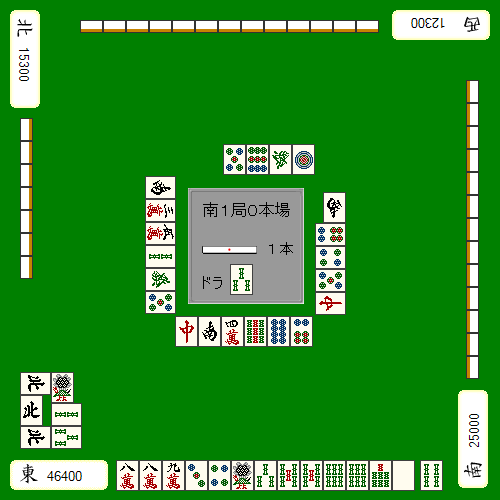
With this many points already, there is no reason to fight.
The worst possible result is dealing into the player in second place directly below you,
so this is one of those spots where you can state flatly:
"There is nothing to cut here except the genbutsu ."
Answer: cut
Original Japanese page: http://beginners.biz/osihiki/osihiki04.html