The Basics of Calling Decisions
Building on the previous page, let us think about how to judge whether you should call or stay closed.
Example 1


 Discarded Dora
Suppose you are a non-dealer in East 1, and on turn 3 you have a hand like Example 1 when someone discards .
Would you call it?
Let us compare the advantages and disadvantages.
Advantage
You secure one han, so the hand becomes easier to win.
Disadvantages
Your defense gets weaker.
The hand will probably be worth only 1000 to 2000 points.
So deciding whether to call or not means:
compare the advantages and disadvantages after calling, and judge which side is larger.
It helps to imagine a scale like this.
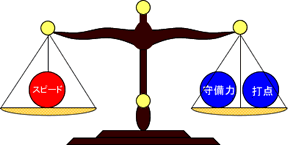
If it tilts left, you call; if it tilts right, you do not.
The important point is that the weight of each side changes depending on the situation.
You cannot simply say, “there are more disadvantages than advantages,” and stop there.
Let us break it down a little further.
Discarded Dora
Speed: It is true that calling secures one han and makes the hand easier to win, but the remaining shape is poor, so even after calling there is still a high chance you will not win.
=> The speed-up benefit is small
Defense: If you aim to win, you will probably need to keep calling, and the hand does not look like it will reach tenpai early, so it is quite dangerous. You also do not have the dora yet.
=> The defensive downside is large
Value: It will probably end up being only 1000 points, but even if you stay closed the hand is not expensive.
=> The downside from losing value is small, but the hand is cheap either way.
If you also take into account the turn number and the fact that you are a child player in East round, the scale looks roughly like this:
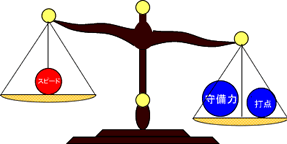
It tilts to the right.
That means it is probably better not to call.
Example 2


 Discarded Dora
Now suppose it is South 1, you are dealer, you are in second place with a 2000-point gap, and on turn 6 your upper player discards .
Let us think about it the same way.
Speed: It improves a lot. Even if you reach tenpai while staying closed, if the final wait ends up being , the hand will still be hard to win.
Defense: Even at most, you only need to call two more times. Also, because this is a Tanyao-style hand, its defense is not very good even if you keep it closed.
Value: If you stay closed and riichi, the hand is usually worth 7700 or more, so the drop in value is large.
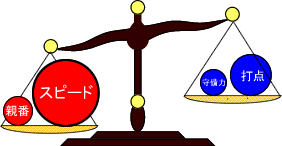
And since you are dealer, winning also means a repeat dealership,
which makes the benefit of calling even larger.
So in this case, calling is clearly better.
This way of comparing the advantages and disadvantages
is the foundation of all situational judgment.
Strong mahjong players are strong because the balance of this scale is more accurate in their heads.
Original Japanese page: http://beginners.biz/naki/naki02.html