Open Tanyao
Tanyao is a very convenient yaku because it still counts even after you open the hand.
But just because it is easier to win with does not mean every hand should be pushed toward open Tanyao.
Example 1


 Dora
Dora 
With a hand like this, it is clearly wrong to start opening from the early game just to win 1000 points.
You finally have a chance hand, and opening it here would only ruin it.
So in what kinds of cases should you actually go for open Tanyao?
When You Have Two or More Dora or Red Fives
If you already have two or more dora or red tiles, then from a value standpoint there is no need to stay attached to menzen.
Example 2


 Draw Dora
With Example 2, you should cut and lock in Tanyao,
then chi without hesitation on shapes like

 .
.
If you have Tanyao plus three dora, then you should call aggressively and go take the win.
When Any Win Is Good Enough
In a situation like the final hand where you are only a tiny amount behind second place and any win gives you first,
then even a good closed shape that you normally would not open should be turned into a 1000-point Tanyao win.
Example 4


Even a hand like this may need to be opened and won depending on the situation.


Some players may feel it is too wasteful to open here.
But if your goal is to play winning mahjong, then in these situations you have to call.
When Staying Menzen Will Be Too Slow
Players who are truly good at calling are not only good at the mechanics of calling,
they are also better at judging when to start calling.
Example 5
 Dora
Dora
Example 5 is also a candidate for mangan.
But no matter how valuable a hand is, it has no value at all if you cannot win it.
This hand is still only two-shanten, and reaching tenpai while staying menzen still looks like it will take a lot of time.
If the hand is already late, or there are clearly faster players at the table,
then you need to give up on staying closed and start calling.
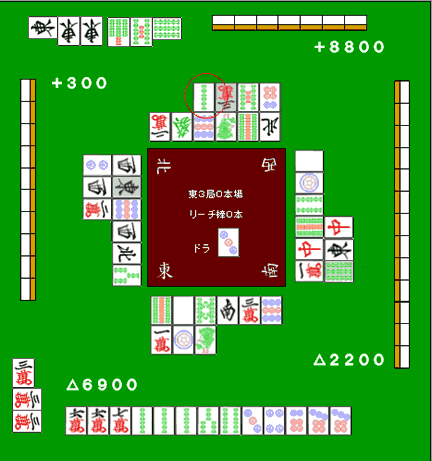
In a situation like this, you should call pon on without hesitation.
Of course you want to recover your losses all at once with a closed riichi hand,
but once two other players have already started opening, you cannot keep waiting.
If you are dealer in particular,
you should decide to call earlier than a non-dealer would,
because preserving the dealership matters too.
If you build too leisurely, you may lose that valuable dealer turn altogether.
So far, every shape we looked at was a good one.
But what about bad shapes?
Example 6


 Dora
Dora
You must never start opening a shape like this.
Yes, it is probably true that you cannot win it unless you go for open Tanyao.
But the real problem is that even if you do go for open Tanyao, there is still no guarantee you can win.
Chi  Pon
Pon 
The only time you should make calls like this is when you are cornered to the absolute limit,
for example as the dealer in South round when dropping the dealership would almost certainly mean last place.
Once someone declares riichi, the risk of a hand like this becomes far too high.
If you start making calls like this from East round, your game is only going to get harder and harder.
When the shape is poor and the hand is cheap, you must not call.
Open Tanyao in particular has weak defense,
and it is one of the open-hand types most likely to deal in.
Once you decide to call, it is crucial that you can reliably finish the hand.
So if you are going for a 1000-point or 2000-point open Tanyao hand,
it should at least be a good shape.
Original Japanese page: http://beginners.biz/naki/naki08.html