Tile Restriction (2)
Let us think about tile restriction through concrete examples.
The Player Below Is Going for a Flush
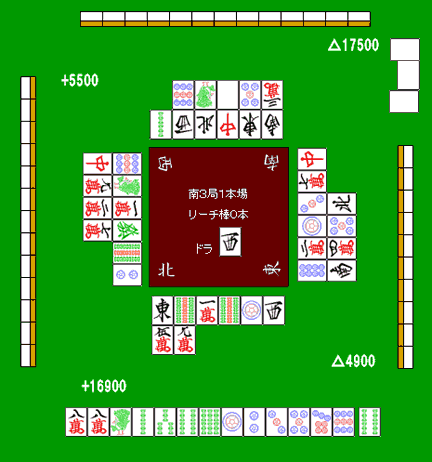
Many tile-restriction situations come up when the player below is going for honitsu. In this example, the player below is very clearly on a souzu flush.
On top of that, the conditions are stacked:
- the opponent is the dealer
- you are in first place in the South round
The dealer is probably not in tenpai yet, but you should still be restricting souzu here.
Your own hand is one-shanten, but:
- it has no yaku
- the shape is poor
- even if you do reach tenpai, you do not want to cut souzu anyway
Of course, you could also keep one-shanten by cutting pinzu.
But a tile like  is exactly the sort of tile
you may want to keep later as an escape tile if two players riichi in succession.
is exactly the sort of tile
you may want to keep later as an escape tile if two players riichi in succession.
So the better play here is to drop the pair of  ,
which lets you avoid releasing souzu first.
This is the kind of position where you restrict firmly
and aim for a noten dealer drop.
,
which lets you avoid releasing souzu first.
This is the kind of position where you restrict firmly
and aim for a noten dealer drop.
A Yakuhai in an Atozuke Hand
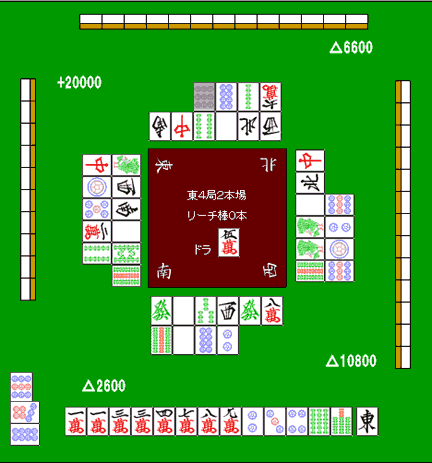
In this example, the dealer has called from a ryanmen shape,
and the tile you happen to draw is  .
I think this tile should absolutely be restricted.
.
I think this tile should absolutely be restricted.
The dealer's calls do not really look like:
- honitsu
- ittsuu
- 789
- chanta
Those routes all look unlikely. Once you also take into account which yakuhai have already appeared in the pond, almost only one explanation remains: double-East atozuke.
So realistically, only two choices remain:
- cut
 and take the stance of "I will never cut East; if I can keep a formal tenpai, that is enough"
 - begin a full fold outright
The one thing you cannot do is just slam down .
That is far too reckless.
A tile you cannot cut is a tile you cannot cut. And if the dealer in first place is allowed to keep accelerating here, the game becomes very difficult. So this is a spot where you should restrict even with the mindset of going down together if necessary.
Restricting for Both Defense and Attack


 Tsumo
Tsumo 
If this were just a flat "what do you cut?" problem,
then from the viewpoint of tile efficiency
and the possibility of drawing  to make tanyao,
dropping the pair of would be the standard answer.
But what if the table looks like this:
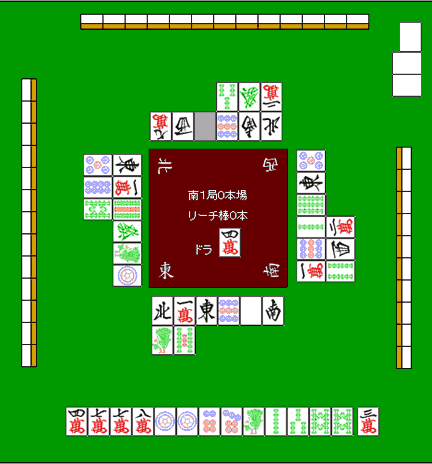
Now you cannot just follow pure tile efficiency.
It is not even fully clear whether the player below is in tenpai,
or whether their hand is expensive.
But if you cut ,
the chance that they chi it is too large to ignore.
Even if they chi and your own points do not immediately go down, the player below definitely gets closer to winning, and the chance that you lose your dealership rises with it.
Your own hand also contains dora and is well worth trying to complete. So rather than prioritizing the possibility of turning it into tanyao, you should give more weight here to restricting the player below's calls.
That is why the correct discard is .
If you cut that tile, the player below should not be able to move.
Original Japanese page: http://beginners.biz/mamori/mamori12.html