Situation and Riichi Judgment
In Chapter 6, I wrote that once you reach tenpai,
in most cases you should riichi.
Here, however, we will look at examples where the situation changes that decision:
There are times when a hand you would normally riichi
should instead be left in damaten,
and there are also times when a hand you might usually keep damaten
should not be kept quiet.
Over-the-Wall Honor Dora Tanki
Suppose you reach chiitoitsu tenpai like Example 1.
Example 1


 Tsumo Dora
Of course, you can simply take the dora tanki wait.
But suppose Kamicha just discarded the dora,  .
.
In a case like this, leaving the hand in damaten for at least 1 to 2 turns is a very strong play.
Since nobody called pon on it,
even if Shimocha or Toimen is holding it,
they probably only have one copy.
After the middle of the hand, holding an honor-tile dora often makes the hand cramped,
and players often end up in the state of
"I want to cut it, but I cannot, so I am forced to keep it."
If someone discards the dora at that point,
you can instantly match it.
That matching discard is exactly what you are hoping for.
However, if nobody discards the dora during those 1 to 2 turns,
then either nobody has it,
or the players who have it are not in a hand shape that will let them cut it.
At that point, either staying damaten
or riichi-ing and betting on tsumo can both be reasonable.
A Tile Safe Against Riichi
Example 2
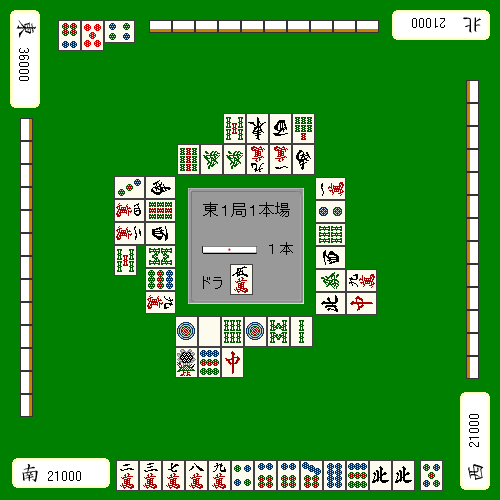
In a situation like this, the better play is to stay damaten and wait for

 to come out,
while retreating the moment you draw a tile dangerous against the riichi.
This hand is not one you should chase too deeply.
Even if you riichi, the hand does not score very well,
and if you deal into the dealer, the damage may be fatal.
If you are going to fire a chasing riichi even on a genbutsu wait like this,
then I think you should want at least a good-shape 2-han hand or better.
Riichi Judgment in South Round
Once you reach the South round, the score situation becomes important.
Example 3
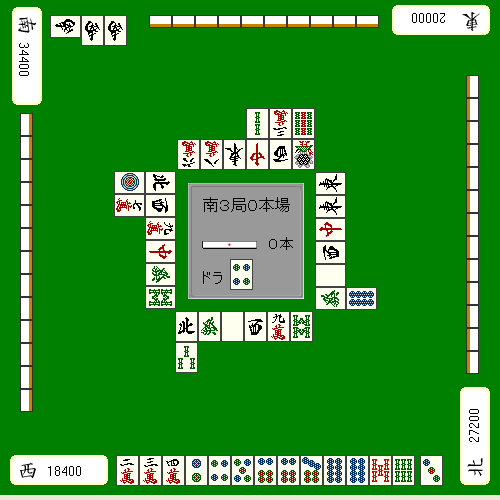
This is a fighting hand when you are in last place in the South round.
On a hand like this, immediate riichi is the only real choice.
Of course, you can still find reasons for damaten, such as:
- the wait does not look easy to win on
- the hand is already mangan even without riichi
But if you look at the score situation,
what you want here is not mangan.
What you want is a hanetsumo.
Even after you riichi, the dealer is still likely to fight,
and depending on their hand, Shimocha may also deal in.
And even if everybody folds,
this is still the kind of spot where you must bet on a

 tsumo.
Example 4
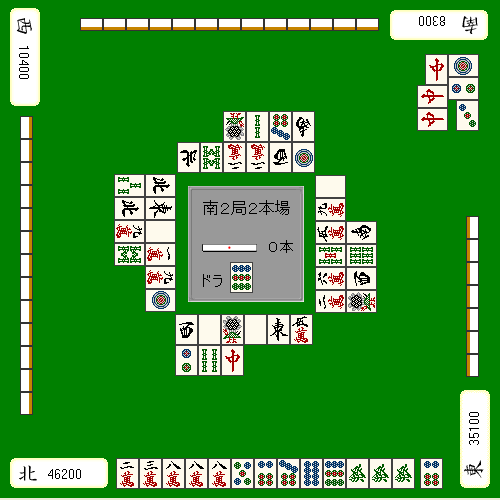
It is South 2. You are in first place, but Shimocha is chasing hard.
From the look of the table, Shimocha is very clearly going for a pinzu flush.
All 4 copies of  are visible,
so is what is called a "dead tenpai."
Of course you cut  ,
,
but here you should hold yourself back from riichi.
No matter how good the wait looks,
if you riichi, the two players fighting over last place may both fold completely,
which can freeze up .
The highest priority in this hand is simply ending this dealer round.
What matters most is to collect a steady win.
You do not need mangan here.
Even 3200 is enough to become a decisive blow.
Also, while the chance is not high,


 Tsumo
Tsumo
even if you are forced to draw  ,
,
you can still turn around and switch the wait to  .
.
As these examples show,
once you reach the South round,
you need judgments built around placement awareness.
On the next page, we will move on to the final hand,
where situational judgment matters the most.
Original Japanese page: http://beginners.biz/joukyou/joukyou06.html