Defense Fundamentals
The ideal defense in mahjong would be to stop only the actual winning tiles and discard everything else. In reality, of course, that is impossible. You can narrow down an opponent's winning tiles through reading, but in practice even then you will not be right thirty percent of the time.
When defending, the most important question is whether the opponent is actually in tenpai.
This is obvious, but crucial: if the opponent is not in tenpai, then no discard can deal in.
That is why defense is mainly about how you respond to riichi. A player who declares riichi is openly telling you:
- I am in tenpai.
- Any tile you discard from here could deal in.
So you cannot afford to throw tiles carelessly anymore.
The Strategic Choices Between Defense and Attack
As the chart below shows, these choices can be broadly divided into five strategies.
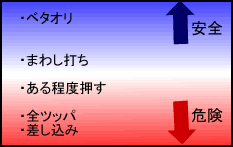
If you are willing to give up on winning in order to avoid dealing in, then naturally you choose full folding.
If you are still pushing toward a win, then you are taking the full push route.
Five strategies are listed here, but while you are still getting used to defense, thinking in terms of just two choices is enough: full folding or full push.
Deliberate deal-in strategies only appear in special situations.
What Is Full Folding?
Full folding means giving up on your own win and committing yourself completely to defense.
This is the foundation of all defense.
The concrete procedure for full folding will be explained later.
Maneuvering
Maneuvering means avoiding dangerous tiles while still trying, as much as possible, to reach a win or at least tenpai.
Because this requires both reading and controlled hand-building, it is quite difficult.
It can be effective under rules such as competitive mahjong, where noten penalties are heavy, or in three-player mahjong, where there are fewer tile types.
But in red-five inflation mahjong, it is not quite as effective as many people imagine.
Put More Weight on Defense
You often hear the advice: beginners should learn full folding first.
That advice makes sense. Full folding is relatively easy to learn, and it directly improves results.
Many beginner and intermediate players are simply attacking too much.
Of course, folding is not the most exciting part of mahjong.
But if your goal is really to become stronger, then improving this area is absolutely necessary.
Raise your defensive level, and your results will become much more stable.
Original Japanese page: http://beginners.biz/mamori/mamori01.html