Suji (1)
When someone declares riichi, the thing you should be most careful about is a ryanmen wait.
Unless the opponent is a total beginner who has only just learned mahjong,
they will normally accept a shape improvement if a kanchan or a pair can turn into a ryanmen.
By contrast, with kanchan, penchan, or shanpon waits,
they may even choose not to riichi right away, hoping to improve into a better shape first.
That is why riichi waits are so often ryanmen waits.
There is data suggesting that about two-thirds of all riichi waits are ryanmen waits.
The theory used to avoid dealing into those ryanmen waits is called suji.
The Six Suji
First, look at all the possible ryanmen waits in full.

 ... 1-4 wait
 ... 2-5 wait
 ... 3-6 wait
 ... 4-7 wait
 ... 5-8 wait
 ... 6-9 wait
These six are the complete set of ryanmen waits.
You should memorize all six of them completely. Since each pair is spaced by 3, they are not hard to remember.
The Three Groups
If you look again at those six waits, you will notice:
1-4and4-7overlap on42-5and5-8overlap on53-6and6-9overlap on6
And if you think back to three-sided waits:
... 1-4-7 wait
... 2-5-8 wait
... 3-6-9 wait
you can see that three-sided waits are just combinations of those overlapping waits.
So in the end, the six suji can be compressed into three major groups:
1-4-7
2-5-8
3-6-9
These six suji and these three groups are extremely important.
You should simply treat them as basic mahjong common sense.
What Suji Tells You
There are only two principles at work here:
- If a player has discarded one of their own winning tiles, they are furiten and cannot ron on it.
- There are only six possible ryanmen waits in mahjong.
From those two points, you can work out that certain tiles will not deal into a ryanmen wait.
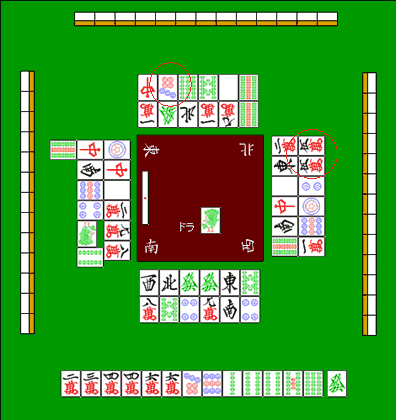
Now go back to this example.
The player across from you discarded  after the riichi, and the player below you discarded after the riichi.
They cut those tiles because they are suji.
First, look at .
The riichi player has already discarded  , so there cannot be a ryanmen shape of
 .
.
Even if there were, it would be furiten and could not ron.
So if you discard , at least you will not deal into a ryanmen wait.
Now look at .
is a suji tile derived from both and .
Originally, could deal into two different ryanmen waits:
But the riichi player has already discarded both and .
That means either case would be furiten and could not ron.
So can also be considered a relatively safe tile.
Original Japanese page: http://beginners.biz/mamori/mamori03.html