Shanten Reversal
To state the conclusion first:
there are actually not that many cases where stepping back in shanten makes you win faster in the end.
Most such cases involve aiming at yaku like Tanyao or Honitsu.
Because you can later call, the hand becomes faster in practice once open-hand options are considered.
Another case is when the current wait has almost no tiles left, such as a kanchan where one of the key tiles has already been ponned.
So in general, it is fine to think of it like this:
shanten reversal is basically a technique used to improve score.
1. Declining Tenpai
Example 1


 Tsumo Dora
As already explained, kuttsuki tenpai has wide acceptance but often ends on a bad wait.
If a draw like Example 1 breaks both Tanyao and Pinfu, then declining tenpai is better.
Here you should discard  ,
,
preserve at least Tanyao, and aim to riichi after that.
Example 2
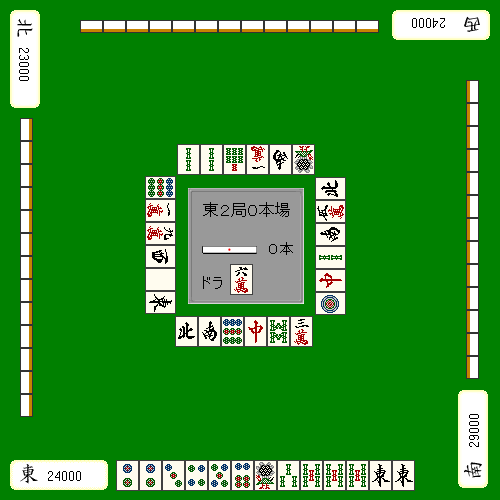
If you pon double East, the hand reaches tenpai.
However, the waiting tile  has already appeared three times on the table.
So here, discarding and declining tenpai is a strong play.
Moving the hand toward waits like 

 or
or

 is obviously easier to win with.
2. Returning to Two-Shanten
There are also cases where stepping back to two-shanten is better because it lets you build in Tanyao or Pinfu.
Example 3


 Tsumo
Tsumo
The pen  is the bottleneck in this hand.
Discarding and stepping back to two-shanten is the good play.
Of course, there is also a line where you discard  and keep the possibility of immediate riichi after drawing .
But if the souzu side forms two completed blocks first, it is better to keep the line that still preserves the shanpon backup.
Even if you give up the chance to riichi immediately on a draw,
the hand still looks very likely to become a Tanyao Pinfu riichi soon enough.
Example 4


 Tsumo
Tsumo
Example 4 is the kind of case where the tenpai acceptance is simply too small.
The only tile that reaches tenpai is  .
.
And even if it comes in, the result is only a terrible pen wait.
This is an extreme example, but here you should unquestionably discard  , sending the hand back to two-shanten.
Example 5

 Tsumo
Tsumo
Even though this hand is already one-shanten,
the overall shape is good enough that you still want to aim at Tanyao, Pinfu, and Sanshoku.
So here you should unhesitatingly break the  side.
side.
Shanten Reversal in the Early Hand
The most common case is probably aiming at Honitsu.
Example 6


 Tsumo
Tsumo
Even though the hand is short on taatsu, it is still better to cut  .
.
That means stepping all the way back to three-shanten.
Of course, chasing the shortest route to tenpai is the basic rule of tile theory.
But once you consider both how easy the hand will be to win and how much it will score,
simply “advancing the shanten count” is not always the correct move.
It is important to play while balancing speed and value.
With that, the discussion of tile theory ends here.
The next section moves on to yaku.
Original Japanese page: http://beginners.biz/pairi/pairi20.html