Hand-Building and Situation (1)
Let us think about hand-building according to the turn count.
As a rough guide, you can divide a hand into three stages based on the discard rows:
- Early game (
turns 1-6) - Middle game (
turns 7-12) - Late game (
turns 13-18)
It is useful to think in those three categories.
Basic approach
- In the early game, chase the possibility of yaku and prioritize good shapes.
- From the middle game onward, getting into tenpai becomes the first priority, and with some hands you should already be preparing for the opponents' attacks.
- In the late game, if your hand has not become something that can actually fight, prioritize safety.
Let us go through concrete examples.
Example 1


 Dora
Dora 
With a hand like this, the most solid play is to cut  ,
,
accept the attachment shapes in the manzu and souzu suits, and aim for a clean immediate-riichi route.
But if it is still the early game, it is also perfectly fine to chase value instead,
break the pair of  , and play for more score.
Example 2


 Dora
Dora 
In Example 2, the main line is to decline tenpai and cut .
Anything you draw in pinzu from  to
to  gives you a good-shape tenpai,
and there are also many souzu improvements.
But once you get into the middle game, the pinzu may already be thinning out,
and then those improvements are no longer worth expecting too much from.
In that case, you should switch plans and cut  to take tenpai immediately.
After that, you can still hope for souzu changes or for drawing the dora and making Sanshoku.
Depending on how the souzu discards look, there are even times when you should riichi right away.
Example 3


 Dora
Dora 
If you look only at tile efficiency, then in Example 3 the best play is clearly to break the pair of  .
.
The only thing you lose is itself, so there is not much room for argument there.
But if it is already the middle game or later, I think you should put defense above efficiency with this hand.
You should have a clear sense that expanding a two-shanten hand with no dora is itself dangerous.
So here, it is safer to keep the safe tile and instead start working on the pinzu block.
As a late-game theme, there is also the idea of formal tenpai.
Once the discards have reached the third row, it is often better to prioritize keeping formal tenpai than to keep chasing an actual win.
Example 4


If you are aiming for Pinfu, the standard play is to cut  .
.
But if formal tenpai is good enough, then the right move is to cut  .
.
You can only chi from the player on your left,
but you can pon  or from any of the other three players.
So if your goal is simply to get into tenpai as reliably as possible,
the answer is to cut .
Example 5
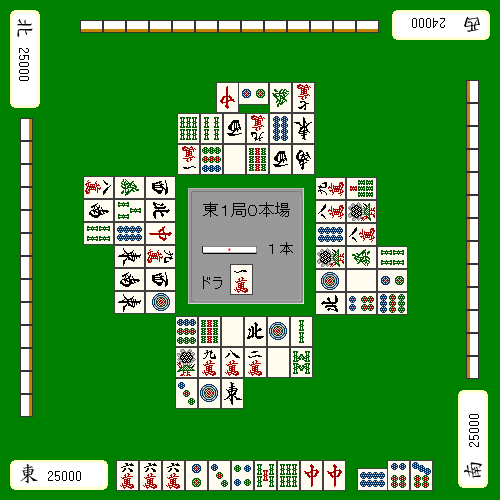
Here is a slightly more advanced late-game technique.
In Example 5, another player has already riichi'd, and you have reached formal tenpai late in the hand.
Kamicha discards  , and there are already two
  visible on the table.
Of course you cannot ron on it, but do you just pass and keep reaching into the wall?
The right play here is to chi and then cut .
That way, even if you draw a dangerous tile next turn,
you can cut another and maintain tenpai.
 Chi
Chi  Chi
Chi 
Original Japanese page: http://beginners.biz/joukyou/joukyou03.html