Effective Tiles and Tile Count
Mahjong is a game of repeatedly choosing one unnecessary tile from your hand and discarding it.
On the previous page, we said that the basic principle is to choose the discard that makes the hand easiest to win with.
So what concrete standard should we actually use to make that choice?
1. Tile Count and Probability
Example 1


In Example 1, unless is unusually dangerous, you should cut .
Let us think about it again. Why is cutting or wrong?
Because cutting gives you the better wait.
Let us compare them directly.
wait on 
wait on
The number of winning tiles is 7 for the first one and 3 for the second.
Of course, some of those tiles may already be in other players' hands or in the dead wall, so it does not mean exactly 7 and 3 are still left in the live wall.
It is also possible that there are no copies at all of left in the wall.
But there is no way to know for certain how many are actually left.
We are not psychics.
So in practice, it is fine to compare the ideal values of 7 and 3 and judge that taking the wait is more favorable.
The more tiles you can win on, the better.
That is one of mahjong's most basic principles.
You cannot win consistently while ignoring it.
wait has more winning tiles
= the probability of winning is higher
= over the long run, taking that wait earns more
This is the kind of thinking that matters.
Mahjong is not a game of competing over who has better intuition.
It is a game of competing over who has the sharper sense of gain and loss.
2. Acceptance Count
In Example 1, we compared waits in a tenpai hand.
But even before you reach tenpai, if you can compare hands by which one has more useful tiles and which one has fewer, the correct discard becomes much clearer.
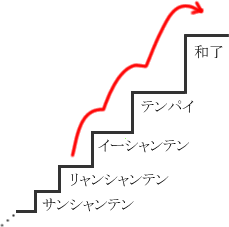
Let us bring back this diagram once more.
When your hand is still far from winning, it is difficult to think directly about the shortest route to agari.
A more practical approach is to aim first for the next step. If you are two-shanten, aim for the quickest route to one-shanten so that you move closer to winning as fast as possible.
The simplest way to think about winning chances in terms of tile count is to compare how many tiles lower the shanten number.
Example 2


Example 2 is a two-shanten hand.
If we list every draw that takes it to one-shanten, we get:

 : 7 tile types, 23 tiles in total.
That is the acceptance count into one-shanten.
Example 3
Example 3 is almost the same shape as Example 2.
But because it is also two-shanten for Chiitoitsu, its acceptance becomes:
: 13 tile types, 35 tiles.
It has far more acceptance than Example 2,
so it is obvious that Example 3 is the better shape.
In this way, counting acceptance lets you evaluate a hand quantitatively.
We will use this way of evaluating hands again and again in later lessons.
3. Shape Improvement
Tsumo
As the tile counts above showed,
if you draw in the Example 2 shape and cut ,
the shanten number stays at two-shanten, but the acceptance count increases.
So must also be treated as an effective tile.
That means there are two kinds of effective tiles:
A: tiles that lower the shanten number (acceptance)
B: tiles that increase the number of A (shape improvement)
Example 4
 Pon
Pon 
 Tsumo
Tsumo
Example 4 is a choice of what wait to take.
The current shanpon wait and the kanchan wait after cutting both have the same acceptance count: 4 tiles.
So here we compare shape improvement.
drawing  or increases the tile count
drawing increases the tile count
Because the shanpon line can improve into a three-sided wait, taking the shanpon is the correct choice.
So when two options have the same acceptance count, one valid method is to compare the number of shape-improving draws.
The important point here is that acceptance count matters more than shape-improvement count.
The foundation of tile efficiency is always to compare acceptance first.
A: tiles that lower the shanten number (acceptance)
B: tiles that increase the number of A (shape improvement)
Sometimes people treat A and B as if they were equal and compare A + B.
That is an easy misunderstanding, so be careful.
Original Japanese page: http://beginners.biz/pairi/pairi02.html