What Is Mahjong?
This site presents my own mahjong strategy around the core ideas of mahjong theory. I want the material to stay as practical as possible, with plenty of tile diagrams so the explanations are as easy to follow as possible. My goal is to organize mahjong theory into a coherent system.
The discussion here assumes that you already know the rules of mahjong and the basic terms. If you do not, it is safer to study A Mahjong Course for Beginners first and then come back.
Before starting the actual course, I want to use this page to make my basic view of mahjong clear.
Mahjong and Luck
"Do streaks, luck, or table flow really exist in mahjong?"
This has been debated constantly for years. Let me state my own view plainly.
It goes without saying that luck matters in mahjong. If you look over a very long span, good luck and bad luck even out and the game eventually becomes a contest of skill. In reality, though, nobody can keep playing one thousand hanchan in a row.
Even if the same group keeps getting together, you might play twenty hanchan at most. Whether you win or lose in mahjong is, for the most part, decided by that day’s luck. Of course mahjong does contain a skill element, but it often takes hundreds or thousands of games before the results finally settle into something that reflects actual ability. If you look at a realistic time scale, you still have to call it luck.
Then do things like "being on a run" or "table flow" actually exist?
I do not deny that they exist. Over the span of just two or three hanchan, it is natural for fortune or misfortune to lean one way. Sometimes you get blessed by the starting hand and by the course of the game. Sometimes your hand is awful, you can do nothing, and you finish dead last. Good stretches and bad stretches can continue for a while, or they can suddenly switch. But I do not think there is any rule behind them. I very much doubt that building strategy around luck or flow is truly effective.
Now let us look at an example.
You have already won the first two games, and in the third you have just drawn a 6000 all, putting yourself far in front.
In the middle of that perfect run, the dealer declares riichi.
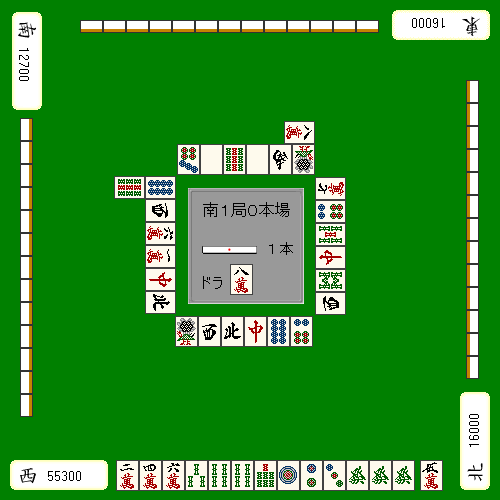
If you still ride the momentum and cut  or
or  , you are probably one of the losers.
"I'm running hot, so I won't draw the dangerous tile."
"If I back off here, I'll lose my momentum."
This is not so much occult thinking as it is making up a reason to keep pushing. If you look at the score situation normally, there is no reason to fight here.
The correct answer is to break the concealed triplet of  and defend.
Even among people who believe in flow, some will still choose to fold here, saying, "If I deal in now, I'll lose the good flow I've built up." But how persuasive is that really?
Flow is the sort of thing you never know how long it will last.
Just because you have been lucky so far does not mean the next result will also be good.
Even if a die has shown 1 three times in a row,
the probability that it shows 1 again is still only 1/6.
Luck and flow cannot be predicted,
let alone summoned by human effort.
No matter how brilliant your last play was,
mahjong is not so generous that good fortune will simply come flying in from the next hand onward.
Mahjong is a gambling game in which luck controls most of the outcome, and skill is slow to show itself in the results. Even if you work hard and become much better, you can still lose easily to an obviously weaker opponent if luck is not with you.
Luck, hot streaks, flow, all of it is decided by the gods. If luck is absent and the flow is bad, there is nothing you can do. Accept it.
The Purpose of Mahjong
Most people who come to this site are probably thinking, "I want to get stronger at mahjong." More concretely, they are probably playing with goals such as:
- improving their mahjong winnings
- raising their rating in mahjong games
- earning titles in mahjong games
I imagine many players sit down with goals like these.
But these are not the only possible goals in mahjong. Some people are obsessed with taking first place. Others care less about results and more about making expensive hands, including yakuman.
For example, consider this hand:
Example: 


 Tsumo Pon

One possible approach is not to win immediately, but instead cut and chase Dai Sangen.
There may be a more profitable answer if you think only in terms of gains and losses,
but how you choose to play is entirely the player’s own freedom.
There is no rule forcing one value system on everyone.
Everyone has a different view of mahjong. People often criticize things like taking a win that locks in fourth place, but do not become the sort of arrogant player who forces your own values on others.
The only things in mahjong that truly deserve criticism are actions that obstruct the smooth progress of the game, such as cheating or intentional delay.
This site is written with the aim of improving your mahjong results. That said, I am not claiming that the style of play introduced here is the one and only correct answer. I want to make that clear now so there is no misunderstanding.
The actual course begins on the next page.
Original Japanese page: http://beginners.biz/kihon/kihon01.html