Maneuvering
Maneuvering means suppressing dangerous tiles while still aiming for a win,
or at least for tenpai.
In practice, this option usually appears after an opponent declares riichi in one of these two situations:
- you are not in tenpai yet, but still want to aim for a win or tenpai
- you are in tenpai, but pushing as-is is too unfavorable, so you want to break the hand once and go around
In those spots, "maneuvering" becomes a possible choice.
More concretely, there are four methods:
pair drops / taatsu drops / triplet drops / chiitoitsu
Pair Drops
This is the standard method of maneuvering. Once a tile passes once, it often passes again, and dropping a pair does not destroy your hand structure too badly.
Example 1
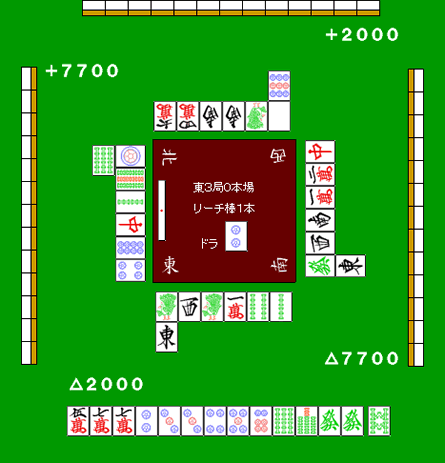
This is a clear example where maneuvering works well.
If you fully fold, it feels painful to tear out core parts of the hand like
 and
and  .
But pushing right now with
.
But pushing right now with  is still a little too harsh.
Here, dropping the pair of  , with one copy already visible in the pond, is a strong play.
The ideal route is to end up chasing with a men-tan-pin + dora 1 riichi.
, with one copy already visible in the pond, is a strong play.
The ideal route is to end up chasing with a men-tan-pin + dora 1 riichi.
Taatsu Drops
Let us look at this with another concrete example.
Example 2
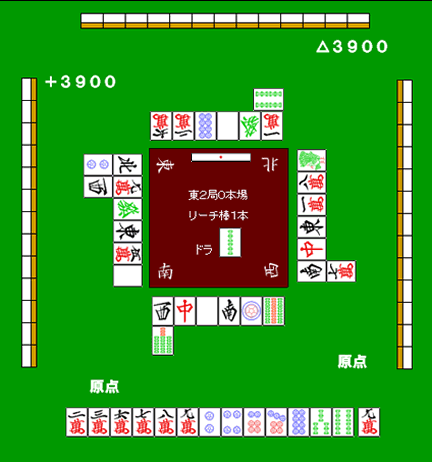
If there were no riichi on the table,
the normal play would be to drop the pinzu kanchan.
Even if you were simply full-pushing, that would still be the standard play.
But if you want to maneuver,
this is a  discard.
If you draw directly, you can riichi immediately.
discard.
If you draw directly, you can riichi immediately.
Even if you stay in one-shanten, draws like 
can make even a suji tile like  acceptable to keep cutting.
By contrast, even though it is also a maneuvering line,
cutting  here is bad.
That is because the dora is  ,
,
and the tile you will eventually have to fight with,  , is dangerous.
So when you maneuver by dropping a taatsu, it is best if both tiles in that taatsu are relatively safe.
, is dangerous.
So when you maneuver by dropping a taatsu, it is best if both tiles in that taatsu are relatively safe.
Needless to say, if you cut and the hand still does not move forward,
while you keep drawing dangerous tiles,
you should switch quickly into a full fold.
Triplet Drops
Sometimes, while you are dropping a whole concealed triplet of safe tiles,
your hand advances during those three turns.
During that time:
- the number of tiles you can safely pass may increase
- your hand may naturally move closer to a winning shape
For example, consider this position:
Riichi pond:


Your hand:


 Tsumo Dora
From a hand like this,
you may drop the concealed triplet of ,
and in the end still manage to win with open tanyao.
Chiitoitsu
This method is not very reliable either.
But when you fully fold against riichi by cutting genbutsu,
have you ever found yourself unexpectedly close to chiitoitsu?
Especially when you are stuck holding something awkward like a yakuhai dora,
cannot cut it, and still absolutely want to drag the hand to tenpai,
sometimes the only way is to force the hand into a tanki wait.
At times like that,
taking a shot on chiitoitsu is also one possible method.
Notes on Maneuvering
Maneuvering should only be used in situations where maneuvering is actually appropriate.
Depending on the point situation,
even a hand that still looks a little winnable may need to be fully folded.
On the other hand, there are also times when you must fight even with a somewhat awkward hand.
The number of situations where maneuvering is truly correct is smaller than many people think.
So do not forget:
the foundation of defense is still full folding.
Original Japanese page: http://beginners.biz/mamori/mamori09.html