Sets and Taatsu
Triplets and Sequences
Mahjong winning hands need four sets.
And there are two kinds of set: triplets and sequences.
[Sequence] 


 ... a group of three consecutive tiles
[Triplet] 
 ... a group of three identical tiles
Basically, sequences are easier to make than triplets.
There are only four copies of any tile in mahjong.
If you need three of those four copies, it is natural that triplets are harder to assemble.
However, when calling is involved, triplets become a little easier to make.
You can only chi from the player to your left, but you can pon from any player.
Even so, that still does not make triplets easier than sequences.
A triplet completed by your own draws without calling is called an anko (concealed triplet).
Because concealed triplets are hard to make, yaku such as Sanankou and Suuankou exist,
but those hands are not easy to complete in real play.
In the end, when thinking about mahjong hand-building,
you should still treat sequences as the basic type of set.
Summary and Theory
What Is a Taatsu?
A two-tile shape that becomes a sequence when you draw one more tile is called a taatsu.
There are three kinds of taatsu.
Shape |
Name |
Effective tiles | Number of outs |
  |
Penchan (edge shape) |
 |
4 |
  |
Kanchan (closed shape) |
 |
4 |
|
Ryanmen (open-ended shape) |
 |
8 |
As you can see from this table, ryanmen has twice the number of outs of penchan and kanchan, so it is the best shape.
"Make ryanmen" is one of the most basic fundamentals in mahjong hand-building.
Comparing Penchan and Kanchan
Now let us compare penchan and kanchan, which may look similar at first glance.
The real difference appears when they improve into ryanmen.
To turn the penchan 
 into a ryanmen,
you need to draw and then .
into a ryanmen,
you need to draw and then .
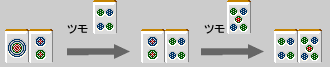
In mahjong, needing a two-step improvement is already a fairly hopeless probability. You can hardly expect penchan to become ryanmen.
If the shape is the kanchan ,
then drawing immediately turns it into ryanmen.
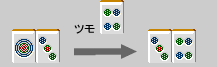
If the improvement only takes one step, then it is still realistic to hope for it.
Moreover, with a kanchan such as ,
drawing either or improves it into ryanmen.
So if you consider improvements into ryanmen, kanchan is clearly better than penchan.
There is also a yaku issue.
An edge wait can never become Tanyao.
So it is perfectly correct to think of penchan as a bad shape.
Summary and Theory
Original Japanese page: http://beginners.biz/kihon/kihon04.html