Mahjong and Probability
When people talk about building a hand in mahjong, some may think the main question is "what yaku should I make?" I think that misses the essence of mahjong.
The essence of hand-building is to make the shape of four sets and one pair.
If you look at mahjong one hand at a time,
it is fundamentally a game of which of the four players completes four sets and one pair first.
Of course the final evaluation is still based on points, but modern mahjong has many dora, including red fives, and high scores are common even without elaborate yaku. Given that game structure, the essence is still not "yaku" but "shape."
And since only the player who completes the hand shape first gets the points, speed naturally becomes essential.
So how do you win faster? The way of thinking needed for that is tile efficiency and probability.
Example 1: Which Tile Should You Discard?


 Pon
Pon
 Tsumo
Tsumo
Let us start with the simplest possible example.
In Example 1, three complete sets and the pair are already finished, so you only need one more set.
If you cut , then drawing or being given  or
or  wins the hand.
If you cut , then only completes the hand.
It is obvious which choice gives the better chance to win.
Example 2: Which Tile Should You Discard?
Pon Tsumo
The two discards that let you take tenpai, a state where you are one tile from winning, are and .
If you cut , your wait becomes and .
If you cut , your wait becomes to .
At first glance both waits seem to involve two kinds of tiles, but that does not mean the chance of winning is the same.
You are already using two copies each of and , so only four tiles remain in total.
By contrast, if you judge only from your own hand, all eight copies of and are still alive.
If you were drawing lottery tickets, you would obviously prefer the side with more winning tickets.
So if you take the wait with more tiles, to , the probability of winning is naturally higher.
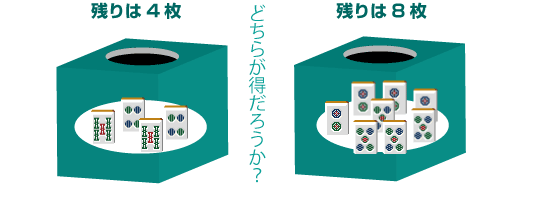
"Choose your discard so that you enter the draw with the most favorable odds."
That is the most basic way to think about hand-building.
Pon Tsumo
For example, even if you cut here,
you may still see or come out first and miss the win.
Even so, do not think, "I should have cut instead."
Mahjong is full of cases where a bad play still happens to produce a good short-term result.
There is no reason to obsess over that kind of purely results-based regret.
Summary and Principle
Original Japanese page: http://beginners.biz/kihon/kihon02.html