Riichi or Damaten? (3)
As the last page showed, if the tenpai is a good shape, you can usually riichi without hesitation.
So how should you judge things when the wait is bad?
Tenpai with No Yaku
Let us first think about hands that have no yaku unless you riichi.
Example 1


 Dora
Dora
In a shape like Figure 1, I think riichi is fine as it stands.
More than that, if the opponents' movement is not causing any special concern, you should riichi.
Why?
Because the only truly effective improvement in this hand is  .
.
If you draw and turn it into a shanpon wait, ron may become a little easier,
but that is not really a dramatic improvement.
If you are going to wait for specifically,
then why not just expect to draw  and win?
Also, the chance of first drawing  is exactly the same as first drawing .
And if comes first, then even drawing afterward leaves you furiten.
So rather than waiting to riichi after drawing ,
you should simply riichi the moment you reach tenpai.
Riichi also has the added benefit of making opponents less free to attack.
When you have two or three dora, even penchan or kanchan waits are still fine for riichi.
Example 2


 Dora
Dora
Of course, it is important to try to build good waits whenever possible.
But if the hand ends up in a poor wait anyway, then that is simply how it is.
Ryanmen waits are easier to win on, yes, but they are not literally twice as easy.
Even with penchan or kanchan, there are still ways to win by ron:
for example, a later hook wait, such as drawing after riichi in this hand.
There are also one-chance and no-chance situations.
In Example 2, that would mean cases where three or more copies of  are already visible on the table.
That can still create real ron potential.
So as a basic rule, even if the tenpai has no yaku and the wait is ugly,
if you have at least one dora, immediate riichi is still the standard play.
That is because the scoring increase from riichi is large.
Theory Summary
Even without a yaku, if you have dora or red fives,
an ugly-shape riichi is completely acceptable.
That said, there are still cases where damaten is better.
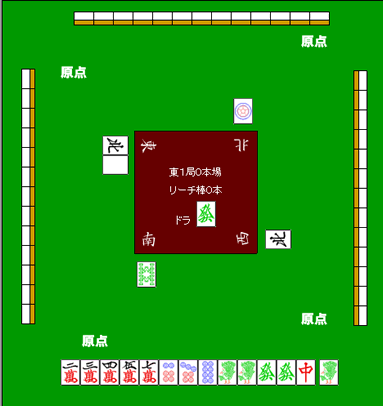
In the position above, you already have a tenpai with two dora on only turn 2.
Here, it is clearly better not to riichi and to wait for improvement.
Thinking, "there are still sixteen turns left, so I will probably win anyway,"
is far too optimistic.
Not only is a kanchan wait hard to win on, but this hand still has many improvements left.
In the manzu suit alone,

all turn the hand into a ryanmen shape,
and you can also pon the dora and take a nobetan route.
Even if you simply tsumo as it is, the hand still becomes 1300/2600, so it does not feel like much of a loss.
Hands like this, with many available improvements despite an ugly-shape tenpai, are real candidates for damaten.
If the hand has no dora:
- the point gain from riichi is not especially efficient
- and by staying damaten, you keep the option of folding if someone else riichis
Because of these two factors, the judgment shifts somewhat toward damaten.
If almost no improvement is possible, then riichi immediately.
But if there are around three improvement types or more, damaten is often stronger.
In truth, this is a hard area to reduce to a rigid rule.
Even among bad waits, there are major differences in how easy they are to win on.
And the more delicate the judgment, the more strongly it depends on table conditions and score situation.
That is why there is only limited value in trying to force all of this into a neat formula.
Example 3


 Draw
Draw  Dora
Dora
There is one important thing I want you to remember:
with a hand like Example 3, there is a third option besides damaten and riichi:
decline the tenpai.
In a neutral table, this hand should cut and break tenpai.
Not only can the souzu continue to improve, but the manzu around dora and the already-promising pinzu can also grow further.
Turning a hand like this into a mere riichi-only 1300 is bad play.
Declining tenpai comes up often and is an important skill.
Tenpai with an Existing Yaku
If the hand already has a yaku, then damaten can still win by ron.
So if the hand has many improvements left, damaten is fine.
Example 4
 Draw
Draw
In Example 4, the only improvement is .
Unless the dora is , this is immediate riichi.
(If the dora were , there might be cases for damaten instead.)
Example 5


Example 5 has a fair number of improvements, so you can stay damaten and riichi only after drawing something like
However, some hands lose the yaku when they improve.


In these kinds of cases, you can remember the rule this way:
If damaten is already worth 5200 or more, take damaten. If it is only 2600, riichi immediately.
Even with a bad wait, it is wasteful to let a good hand end at only 2600.
So even on kanchan or penchan, riichi is still correct.
If the hand is already worth 5200, riichi is still possible of course,
but then the decision depends on the score situation and the table.
Original Japanese page: http://beginners.biz/reach/reach04.html