South 4 Strategy (1)
South 4 is the hand that tests your situational judgment the most.
Above all, you must know exactly
"how many points I need to move to what place."
Score Gap Reduced by Tsumo
If you are dealer, you can still get away with winning first and then checking,
"Wait, did that flip the ranking?"
But if you are a non-dealer,
you need to know the moment you reach tenpai
whether the hand is actually a comeback hand.
| Winning Tsumo | If the opponent is non-dealer | If the opponent is dealer |
|---|---|---|
| 300 / 500 | 1400 | 1600 |
| 400 / 700 | 1900 | 2200 |
| 500 / 1000 | 2500 | 3000 |
| 700 / 1300 | 3400 | 4000 |
| 1000 / 2000 | 5000 | 6000 |
| 1300 / 2600 | 6500 | 7800 |
| 2000 / 4000 | 10000 | 12000 |
| 3000 / 6000 | 15000 | 18000 |
The 1300 / 2600 case in particular comes up all the time,
so it is best to memorize how much the gap shrinks against a dealer and against a non-dealer.
Another important benchmark is how much the gap shrinks with a mangan tsumo.
"If a mangan tsumo reaches, then aim for the comeback."
It is worth memorizing that as a rule of thumb.
Direct-hit mangan or hanetsumo are not things you can reliably force.
The condition of
"I reach if I tsumo mangan"
is the realistic border line for a comeback.
Conversely, the key is to play the final hand so that
you are within mangan-tsumo range if you are behind,
and outside mangan-tsumo range if you are in first.
Building a Comeback Hand
Just because it is the final hand does not mean you need to get strangely overexcited.
But if you have actually been dealt a comeback hand,
you must not waste the opportunity.
Example 1
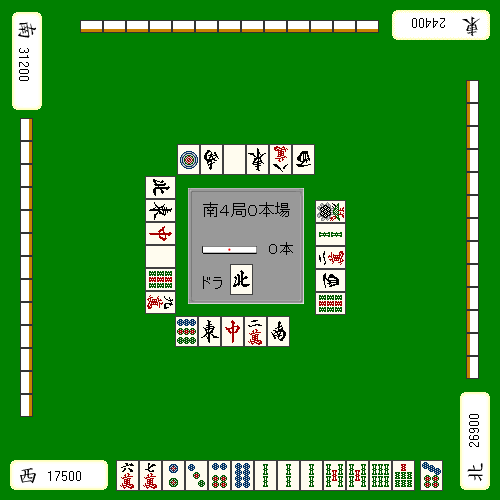
In a flat situation, I think cutting  and prioritizing speed would be fine.
But if you are in last place right now,
and the condition is
"mangan tsumo reaches second, and with a little luck even haneman can take first,"
then you have no choice except to cut

 .
.
This hand already has enough material to fight for that result.
That said, it does not mean the Sanshoku will necessarily come together.
If the hand ends up in a Tanyao-only tenpai,
then an immediate riichi is the realistic choice,
betting on ippatsu, a red five, or ura-dora.
Example 2
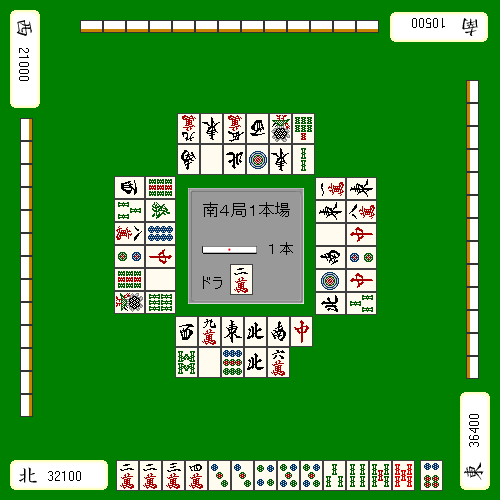
This one is easy.
You are only 4300 behind first place.
With a riichi stick and one honba already on the table,
3900 from anyone is enough to overtake.
So you should simply cut the dora,
and if a callable tile appears, call and take tenpai immediately.
This is not a spot to think about things like
Tanyao Pinfu Sanshoku Iipeikou.
Calling Judgment
If the situation is "a win means first place,"
then you should focus on speed alone.
Atozuke is fine.
Open Tanyao is fine.
Anything is fine.
Example 3


 Discarded:
For example, suppose it is the final hand,
you are only barely ahead of second place,
and you absolutely must protect the lead.
In a case like this,
you should go for the win no matter what it does to the shape.
So if Kamicha discards  ,
,
calling is the only move.
Example 4
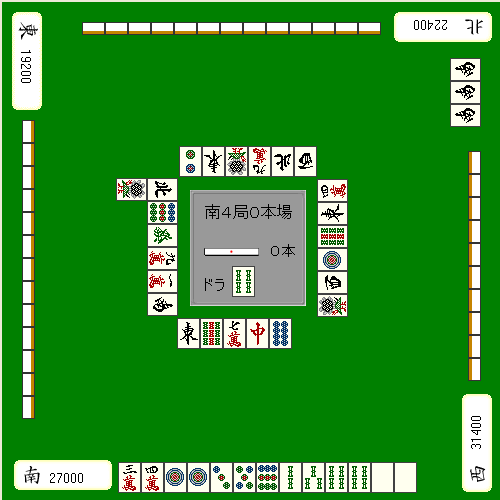
In South 4, you are 4400 behind first place.
The condition is either a 1000 / 2000 tsumo
or a direct-hit 3900.
So the theme of this hand is to make 3900,
or more precisely,
to make White + Dora 2.
That makes  a key tile.
In an all-out South 4 fight like this,
even if you open with nothing more than an atozuke yakuhai hand,
the chance of everyone successfully freezing you out is not that high.
Shimocha has already opened,
so there is not much time left either.
A ron of 3900 still would not be enough,
but you should not underestimate
accidental factors such as drawing a red five,
or Toimen or the dealer putting a riichi stick on the table.
Here I think a decisive chi is best.
Original Japanese page: http://beginners.biz/joukyou/joukyou07.html